Politics and Government of Nepal
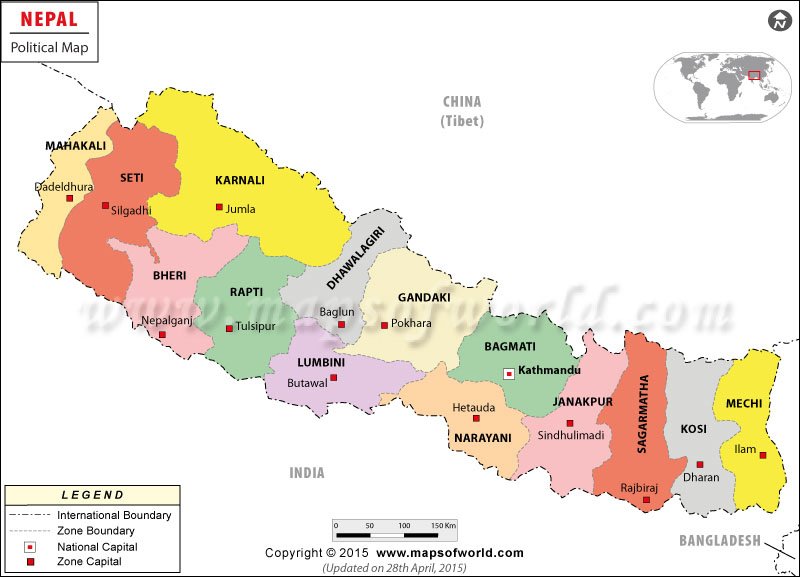
Nepal is a parliamentary republic with a multi-party system.[116] It has three political parties recognised in the federal parliament: Nepal Communist Party (NCP), Nepali Congress (NC),[116] and Janata Samajbadi Party, Nepal (JSPN).[116] Of the two major parties both of which officially espouse democratic socialism, NCP is considered leftist while Nepali Congress is considered centrist.[117] During most of the brief periods of democratic exercise in the 1950s and the 1990s, Nepali Congress held majority of seats in parliament; CPN (UML) was its competitor in the 1990s.[118] After the Maoists entered the political process in 2006, they emerged as the third largest party.[119] In the aftermath of the 2017 elections, the first one according to the new constitution, NCP, formed by the merger of CPN (UML) and CPN (Maoist Centre) has become the ruling party at the federal level and in six out of seven provinces.[120] The Madhesi coalition, comprising Samajbadi Party, Nepal and Rastriya Janata Party, Nepal, which later merged to form JSPN, formed the provincial government in Province No. 2, though it has negligible presence in the rest of the country.[121][122][123] Though Nepali Congress has a significantly reduced representation, it is the only major opposition to the ruling communist party in all levels of government.[124] However, Sher Bahadur Deuba, leader of the Nepali Congress, was appointed as Prime Minister again in July 2021.[125]In the 1930s, a vibrant underground political movement arose in the capital, birthing Nepal Praja Parishad in 1936,[126] which was dissolved seven years later, following the execution of the four great martyrs. Around the same time, Nepalis involved in the Indian independence movement started organizing into political parties, leading to the birth of Nepali Congress and Communist Party of Nepal.[127] As communism was trying to find its footing, Nepali Congress was successful in overthrowing the Rana regime in 1951 and enjoyed the overwhelming support of the electorate.[128] In the partyless Panchayat system initiated in 1962 by King Mahendra, monarchy loyalists took turns leading the government; political leaders remained underground, exiled or in prison.[126] A communist insurgency was crushed in its cradle in the 1970s, which led to the eventual coalescence of hitherto scattered communist factions under the United Left Front. After the joint civil resistance launched by the United Left Front and Nepali Congress overthrew the Panchayat in 1990,[128]